Verdict
Foundation is the most organic-feeling medieval city builder available: beautiful, relaxing and endlessly tweakable. It trades raw difficulty for creative freedom, and the slow early game won't suit everyone.
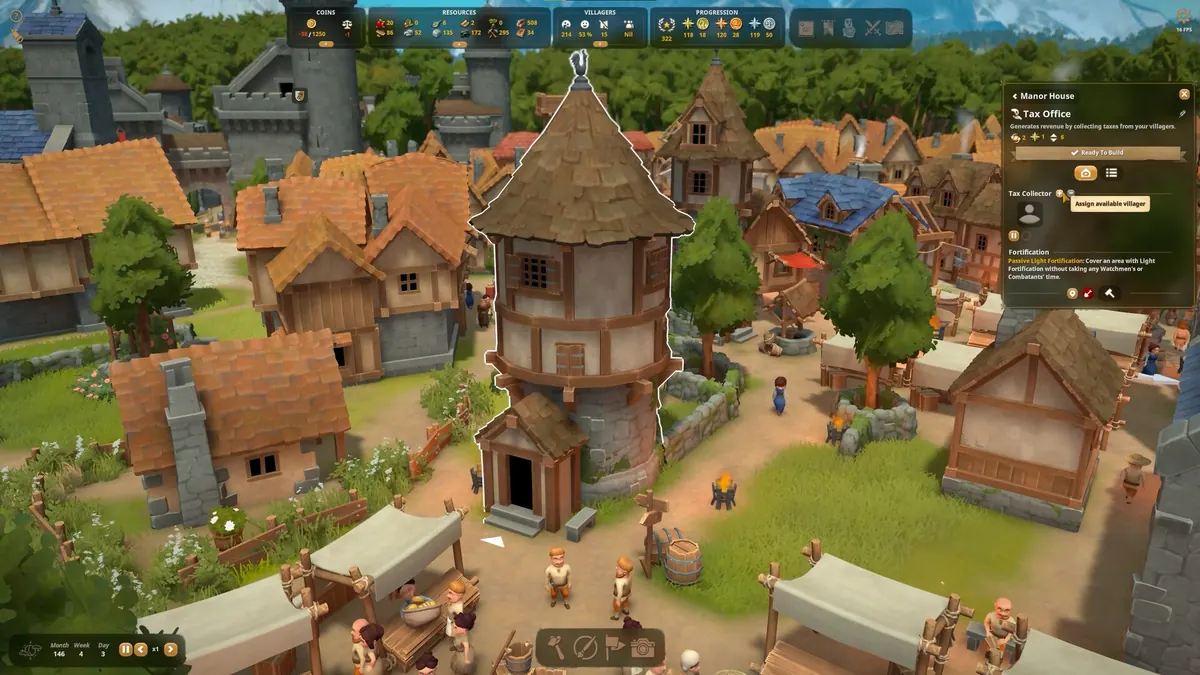
Most city builders hand you a grid and a set of rules. Foundation hands you a meadow and asks what kind of village you'd like to grow. That difference sounds small, but it defines the whole game.
Polymorph Games, a small Canadian studio, kept Foundation in Early Access for exactly six years before the 1.0 release on 31 January 2025. Since then it has received quality-of-life updates and a steady stream of community mods. We went back in for the full release to see whether it holds up.
The Essentials
Foundation is a medieval settlement builder without a grid. You don't place every road by hand. You paint residential zones, and villagers build houses inside them. Paths form naturally along the routes people actually walk. Over time, a hamlet in the woods becomes a winding town whose layout follows the terrain and your villagers' habits.
On top of that sit the classic city-builder loops:
- Production chains: wood, stone, food, tools, cloth and luxury goods, each needing workplaces and workers.
- Villager needs: food variety, religion, safety and goods, which push your population from peasants up through higher social classes.
- Three estates: the Kingdom, the Clergy and the Labour estate. Each wants different things from you, and keeping them happy unlocks buildings and favour.
- Trade routes: outside regions buy your surplus and sell what you can't produce, which matters a lot for luxury goods.
The Experience
The best moment in Foundation comes about two hours into a map. You zoom out and realise your village looks like a real place, not a spreadsheet with roofs. Roads curve around hills, houses cluster near the well and the market spills into the square. No two settlements end up looking alike, and that's not a marketing line.
The monument system is the other standout. Churches, manors, abbeys and the castle added in 1.0 are built from modular parts: walls, towers, naves, bell towers and gates, each with gameplay effects. You can spend an hour designing a cathedral that's both functional and genuinely yours. For creative players, this is where Foundation leaves its competitors behind.
The 1.0 overhaul matters too. Buildings were reworked visually, animations were added, and workplaces like the woodcutter camp, warehouse and stonemason can now be extended with additional parts. A time-of-day switcher and a photo mode make it easy to show off your town. The game is also simply easy on the eyes. Its warm, slightly stylised look reads clearly even when your town is busy.
The Limits
Foundation is a slow burner. The first stretch of a new map, gathering logs and stone and waiting for the first houses, drags, especially if you've played it before. Speed controls help, but the opening still lacks hooks.
It's also not a hard game. Once your production chains are stable, the economy rarely threatens to collapse. Players who want the tight logistics of Anno or the survival pressure of Banished or Farthest Frontier will find Foundation forgiving to a fault. Custom rulesets in 1.0 let you tweak difficulty, but the core design is cosy, not brutal.
Finally, a few requirements are explained vaguely. It's not always obvious why a social class won't upgrade or which monument part unlocks a specific bonus. You'll occasionally end up checking the community wiki.
Who Is It For?
- Creative builders who care about how a town looks and feels: this is a must-play.
- Relaxed strategy fans who want something to unwind with in the evening: excellent.
- Optimisation-obsessed players looking for a brutal economic puzzle: expect less pressure than you'd like, though mods help.
If you prefer kingdom-building with armies and alliances on mobile, our Rise of Kingdoms beginner guide covers a very different, far more competitive take on the genre.
Verdict
Foundation took a long road to 1.0, and it shows in the best way. The gridless building, organic growth and modular monuments give it an identity no other city builder matches. It isn't the deepest or hardest builder on PC, and the early game could move faster. But for turning a meadow into a living medieval town that looks like nobody else's, it's hard to beat.
Rating: 8.0/10. A beautiful, creative and genuinely relaxing city builder that rewards imagination more than optimisation.
More verdicts are on our Reviews page.
Pros
- Gridless building and organic road growth make every village unique
- Modular monuments let you design your own church, manor and castle
- Three estates add light but meaningful political choices
- Gorgeous, readable visuals after the 1.0 overhaul
- Relaxed pacing and mod support give long-term replay value
Cons
- Early game is slow, especially on larger maps
- Economy rarely pushes experienced players hard
- Some building requirements are explained vaguely